Home Workouts for Mental Wellness: How Exercise at Home Can Improve Mood and Mental Health

Exercise benefits mental health, but understanding how and how much can feel confusing. One article says intense workouts are the answer. Another insists gentle movement works better. Social media promises instant mood boosts if you follow the “right” routine. Meanwhile, real life leaves you tired, stressed, and unsure where to start.
Here’s the grounding truth: you don’t need extreme workouts, expensive equipment, or perfect motivation for exercise to benefit mental health. Decades of research show that simple, consistent home fitness habits can meaningfully improve mood, reduce stress, and support emotional resilience-when done in a sustainable way.
This article cuts through the noise. You’ll learn why exercise works for mental wellness, which types of home workouts are most supportive, how much is actually enough, and how to build habits that fit real life.
No hype. No quick fixes. Just evidence-based guidance you can use today.
Table of Contents
The Science Behind Exercise and Mental Wellness
How Exercise Benefits Mental Health
Large-scale research consistently shows that exercise benefits mental health by improving emotional well-being across ages and backgrounds.
Evidence from systematic reviews and meta-analyses published in The British Journal of Sports Medicine and indexed in PubMed shows that exercise can:
- Reduce symptoms of depression by 20–30%
- Lower anxiety symptoms, comparable to first-line non-drug treatments for mild cases
- Improve perceived stress and emotional regulation
- Support better sleep, which directly affects mood
- Increase overall quality of life
Importantly, these exercise benefits mental health outcomes are seen with moderate, consistent activity, not extreme training.
Key takeaway: Exercise supports mental health as a preventive and supportive tool, not a cure-all.
What Happens in Your Brain When You Move
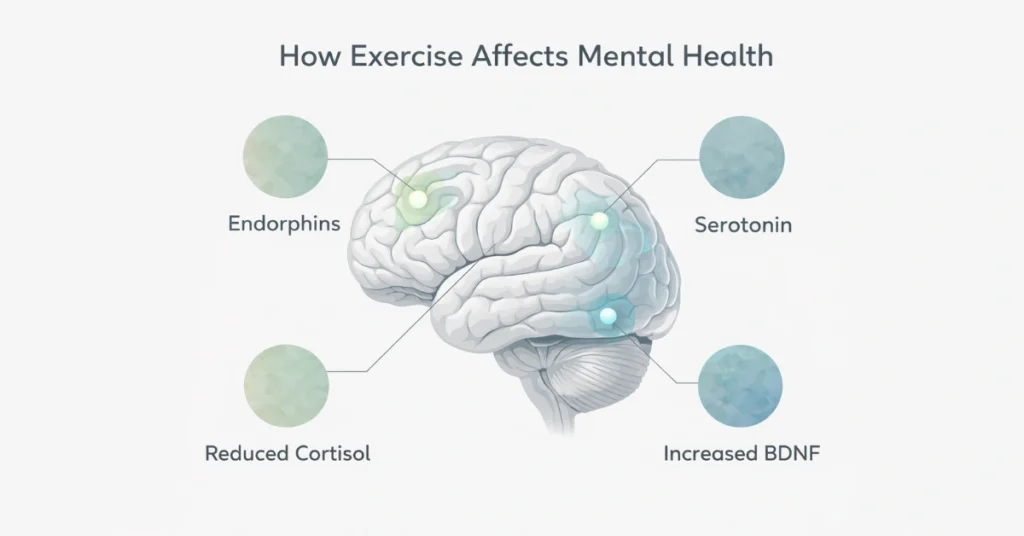
Exercise benefits mental health because it changes how your brain and nervous system function in measurable ways.
When you move your body:
- Endorphins are released, helping improve mood and reduce pain perception
- Dopamine and serotonin activity increases, supporting motivation and emotional balance
- Cortisol (the stress hormone) decreases over time with regular activity
- Brain-derived neurotrophic factor (BDNF) increases, which supports brain plasticity and emotional resilience
Clinical studies show that even 10–20 minutes of moderate exercise can improve mood for several hours, particularly in people experiencing stress or low mood—one of the clearest ways exercise benefits mental health in everyday life.
Why Home Fitness Works So Well for Mental Health
You don’t need a gym to access these benefits. Exercise benefits mental health most when it’s consistent and realistic.
Research on exercise adherence shows that convenience and perceived control are major predictors of long-term success. Home workouts support mental wellness because they:
- Remove commuting and time barriers
- Reduce social anxiety or self-consciousness
- Allow flexible pacing based on energy levels
- Encourage consistency over perfection
For mental health, the way exercise benefits mental health most is by helping you do something regularly, rather than chasing the “ideal” workout you can’t sustain.
Types of Home Workouts That Support Mood

Different forms of exercise support mental health in different ways. The best option is often the one you’re most likely to continue.
Low-Impact Movement for Stress Relief
Low-impact movement is one of the clearest ways exercise benefits mental health, because it helps calm the nervous system and reduce physical tension.
Examples include:
- Walking in place or around your home
- Gentle stretching routines
- Mobility exercises for hips, shoulders, and spine
- Light bodyweight movements (such as sit-to-stand or wall push-ups)
Why it works:
Low-intensity movement activates the parasympathetic nervous system, helping shift your body out of “fight or flight” mode—one of the key ways exercise benefits mental health during periods of stress.
Best for: high-stress days, beginners, and people with chronic pain or fatigue
Strength Training and Emotional Resilience
Strength training isn’t just for muscles-it’s strongly linked to mental health.
A 2018 meta-analysis in JAMA Psychiatry found that resistance training reduced depressive symptoms even in people without a formal depression diagnosis.
Simple home options include:
- Squats or chair squats
- Wall or knee push-ups
- Resistance band exercises
- Light dumbbells or household items
Why it works:
- Builds a sense of competence and self-efficacy
- Improves blood sugar regulation, which affects mood
- Enhances long-term stress resilience
Cardio at Home and Mood Elevation
Aerobic exercise is well-known for its mood-lifting effects.
Home-friendly cardio options:
- Marching or jogging in place
- Stair climbing
- Low-impact dance
- Short cardio circuits (30–60 seconds per move)
Studies show that 15-30 minutes of moderate aerobic exercise can reduce anxiety symptoms for up to 24 hours.
Tip: You should be able to talk in short sentences while exercising-this indicates a mood-supportive intensity.
Mind–Body Workouts
Mind–body practices combine movement with breath and attention.
Examples:
- Yoga
- Pilates
- Tai chi–inspired flows
- Slow, breath-led stretching
Systematic reviews show these practices can significantly reduce stress, anxiety, and perceived burnout, especially when practiced 2–3 times per week.
Why they work:
They improve body awareness and help regulate breathing, which directly affects emotional regulation.
How Much Exercise Do You Actually Need for Mental Health?
The Minimum Effective Dose
You don’t need long workouts to see benefits.
Research suggests:
- 10-20 minutes per session can improve mood
- 3-5 days per week is sufficient
- Benefits increase up to about 150 minutes per week, then level off
More is not always better-especially during periods of high stress.
Signs You’re Doing Enough
Instead of tracking calories burned, watch for:
- Improved mood after movement
- Better sleep quality within 1-2 weeks
- Reduced mental tension
- Slightly higher daily energy
These subjective markers often matter more for mental wellness than performance metrics.
Building a Sustainable Home Fitness Habit
Start Where You Are
Mental wellness improves when exercise feels supportive, not punishing.
That means:
- Choosing intensity that matches your current energy
- Accepting shorter workouts on hard days
- Letting “good enough” count
Consistency matters more than motivation.
Habit-Stacking for Mental Wellness
Habit research shows that pairing a new habit with an existing one increases success.
Examples:
- Stretch for 5 minutes after brushing your teeth
- Do a short walk after lunch
- Strength train while watching a favorite show
Try this for 7 days:
Pick one daily anchor and attach 10 minutes of movement to it.
Tracking Progress Without Obsession
Instead of weight or appearance, track:
- Mood before and after workouts (scale of 1–10)
- Stress levels at the end of the day
- Sleep quality (total sleep time plus how refreshed you feel)
Track just one metric to avoid overwhelm.
Sample Weekly Home Workout Plan for Mental Wellness
| Day | Activity | Duration | Mental Focus |
|---|---|---|---|
| Monday | Gentle strength | 20 min | Confidence |
| Tuesday | Walking/cardio | 15 min | Mood lift |
| Wednesday | Yoga or stretching | 20 min | Stress relief |
| Thursday | Strength | 25 min | Resilience |
| Friday | Light cardio | 15 min | Energy |
| Saturday | Optional movement | 10–20 min | Enjoyment |
| Sunday | Rest or mobility | — | Recovery |
This aligns with World Health Organization physical activity guidelines while remaining flexible.
Common Mistakes That Undermine Mental Health Benefits
- Exercising intensely when already exhausted
- Skipping rest days
- Using exercise to “punish” yourself
- Comparing your routine to others online
Overtraining can increase cortisol and worsen mood, especially when sleep and nutrition are inadequate.
When Exercise Alone Isn’t Enough
Exercise supports mental health—but it doesn’t replace professional care.
This advice may not apply if:
- Exercise increases anxiety or panic symptoms
- You have an active eating disorder
- You’re experiencing severe depression or suicidal thoughts
In these cases, exercise should be guided by a healthcare or mental health professional and combined with appropriate treatment.
Frequently Asked Questions About Exercise, Home Fitness, and Mood
How does exercise benefit mental health at home?
Home exercise improves mood, reduces stress hormones, supports brain health, and builds emotional resilience—without the pressure of gym environments.
Can short home workouts really improve mood?
Yes. Studies show benefits from sessions as short as 10 minutes, especially when done consistently.
Is strength training or cardio better for mood?
Both help. Cardio offers immediate mood boosts, while strength training supports long-term emotional resilience.
How often should I exercise at home for mental wellness?
Most days of the week, even briefly. Consistency matters more than intensity.
What to Try Next
If you’re unsure where to begin, start small and specific.
This week’s challenge:
- Choose one type of movement
- Do it for 10–15 minutes
- Track mood before and after for 7 days
Notice patterns-not perfection.
For deeper support, explore our upcoming AuraEvidence articles on:
- Exercise and anxiety
- Sleep, movement, and mental health
- Building habits that last under stress
Follow us on social media for more tips and updates: Instagram, TikTok, Facebook, Pinterest.
Check out more self-care tips and mindfulness practices on our Mind & Lifestyle page, or explore our other fitness guides on the Home page.
Your mental health doesn’t need extremes. It needs consistency, compassion, and movement that works with you-not against you.